


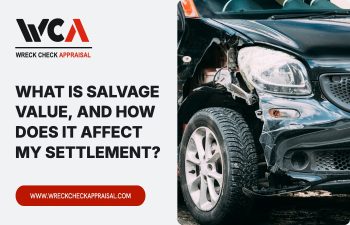
Salvage value is the estimated worth of your damaged vehicle after an accident, reflecting its value for parts or scrap, and it plays a crucial role in determining your insurance settlement – both in whether your car is declared a total loss and in what you might receive if you keep your vehicle.
Understanding Salvage Value: The Quick Summary
If your vehicle is involved in a significant accident, your insurer will assess its pre-accident value, repair costs and salvage value. Salvage value is what a damaged car is likely to fetch at a salvage auction, where buyers are typically looking for fixable vehicles, parts or scrap metal. This figure directly impacts the total loss calculation and your final payout. In short, knowing the salvage value helps you understand why your settlement is what it is – and what happens if you want to keep the car.
How Is Salvage Value Used in My Insurance Settlement?
Salvage value is central to two key decisions:
- Is My Vehicle a Total Loss?
Insurance companies compare the cost of repairs plus the salvage value to your vehicle’s pre-accident market value. If the sum of repair costs and salvage value meets or exceeds the pre-accident value, your car is typically declared a total loss. For example, if your car’s market value was $10,000, repairs cost $7,000, and salvage value is $3,500, the total ($10,500) exceeds the market value, so it’s a total loss. - What Happens If I Keep My Car?
If you decide to keep your totaled car (often called an owner-retained salvage), the insurance company deducts the salvage value from your settlement. This means you’ll get the settlement minus what the insurer could have gotten by sending the car to auction. For instance, if your total loss settlement was $10,000 and the salvage value is $2,000, you’d receive $8,000 and keep the vehicle.
Where Does Salvage Value Come From?
Salvage value isn’t just a random guess. Insurers base this figure on actual auction results for similar vehicles with comparable damage. The value can vary widely based on make, model, year and the extent of damage. Some cars are in high demand for parts, while others might fetch less due to market saturation or low demand for specific components.
What Else Should I Know?
- The salvage value is not negotiable in most cases, but you should always request to see how it was determined. Ask for the data or auction results used to calculate it.
- Salvage value is one of the most important factors in the total loss threshold calculation. If you disagree with the insurer’s numbers, you can get a second opinion from an independent appraiser.
- If you keep your vehicle, you may need to obtain a salvage title from your state’s DMV, which can affect your ability to insure or sell the car in the future.
- The salvage value also impacts your deductible. Your deductible is usually subtracted after salvage value is considered.
Why Trust Wreck Check Appraisal with Your Total Loss Claim?
Wreck Check Appraisal is the nation’s trusted resource for independent, expert auto appraisals and total loss claim assistance. Serving all 50 states, our team has decades of combined experience in vehicle valuation, total loss settlements and diminished value claims. We use real market data, recent auction sales and industry-standard methodologies to determine accurate salvage values and fair market values – not just what the insurance company says.
Whether you’re disputing a total loss offer, need a second opinion on salvage value or want to understand your options, our appraisers are here to help you get the settlement you deserve.
FAQs About Salvage Value and Settlements
What exactly is salvage value?
It’s the estimated worth of your damaged vehicle for parts or scrap, based on real auction data.
How does salvage value affect my settlement?
It determines whether your car is a total loss and, if you keep your car, the amount you’ll receive after the value is deducted.
Can I negotiate salvage value?
It’s possible, especially if you have evidence the insurer’s estimate is too low or too high. An independent appraisal can help.
What happens if I want to keep my car?
Your insurer pays you the total loss value minus the salvage value, and you’ll likely receive a salvage title.
Why should I get a second opinion?
Insurers sometimes undervalue vehicles or overestimate salvage value. An independent appraisal ensures you’re treated fairly.
Get Expert Help with Your Total Loss Claim
If you’ve been in an accident and are facing a total loss settlement, don’t leave your payout to chance. Contact Wreck Check Appraisal today for an independent, expert appraisal of your vehicle’s salvage value and total loss claim. We serve all 50 states and can help you secure the best possible outcome for your unique situation.
Posted on behalf of
P.O. Box 1652
Roswell, GA 30077-1652
Phone: (770) 675-1828
Email: [email protected]